
BuildFirstSite
Web design & development · Australia
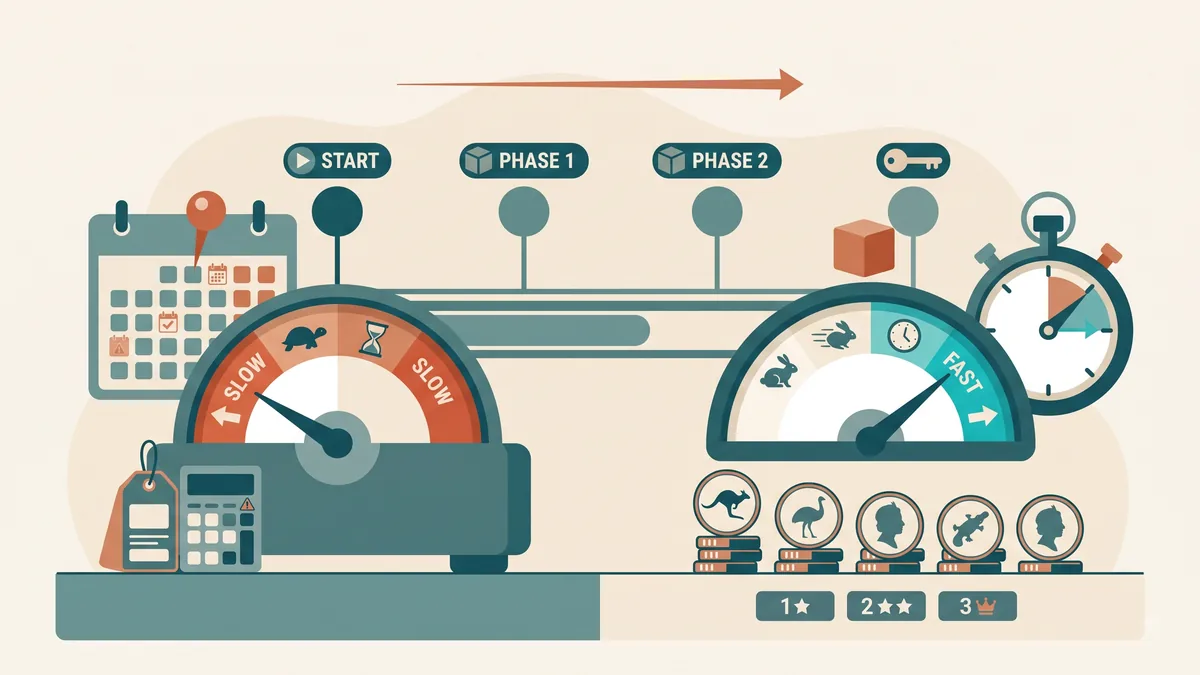
For most Australian small-to-medium businesses, a professional website takes 1 to 6 weeks from initial sign-off to live launch. A focused single landing page can be live in 5 to 7 days; a full multi-page business website takes 2 to 3 weeks; and a custom e-commerce store or SaaS platform takes 4 to 8 weeks. Crucially, the coding itself is rarely the bottleneck — content collection, photo assets, and feedback response times are.
Every successful website project starts with clarity. Before writing code or opening a design file, developer and client align on exact business objectives, key target audiences, competitor positioning, and functional requirements.
During discovery, we map out your sitemap structure (e.g. Home, Services, About, Pricing, Contact, Suburb landing pages) and establish your brand voice. Having a clear brief tied to a fixed pricing tier prevents scope creep and mid-project surprises.
Design turns strategic goals into a visual reality. Wireframes outline layout anatomy — headline positioning, call-to-action buttons, mobile tap targets, and social proof trust signals.
We show full-fidelity interactive mockups on a live staging link rather than static images. This allows you to test mobile responsive navigation, font legibility, and color harmony on your phone before development begins.
This is where clean code is written. Building on modern frameworks like Next.js and React provides dramatic performance advantages over traditional drag-and-drop page builders. Learn more about technology trade-offs in our detailed WordPress vs Custom Website comparison.
With the codebase ready, final copy, team photos, project galleries, and customer reviews are inserted. Quality assurance (QA) testing spans multiple operating systems, browser engines (Safari, Chrome, Firefox, Edge), and device widths.
We run rigorous automated performance checks using our internal audit tooling and Google Lighthouse. Test your current site's performance score anytime with our free website speed checker.
On launch day, DNS records (A and CNAME records) are configured to point your custom domain (e.g. yourbusiness.com.au) to secure hosting servers (Vercel / Cloudflare). SSL certificates are provisioned automatically, XML sitemaps are submitted to Google Search Console, and live Google Analytics 4 tracking is verified.
When a small business website project estimated at 3 weeks takes 4 months, it is almost never due to technical coding delays. In 90% of cases, delays stem from four predictable human factors:
Your choice of underlying web platform heavily dictates speed to market and long-term maintenance overhead:
To see how much an Australian website build costs across different industries and scopes, read our full website cost guide.
A simple one-page landing page can technically be built in 24 to 48 hours if all copy, logos, images, and domain credentials are fully provided on day one. However, high-converting business websites with custom design, mobile optimization, and local SEO setup usually require 1 to 2 weeks for proper execution.
The #1 cause of website build delays is waiting for content from the client — specifically text descriptions, service lists, high-res photos, and prompt review feedback. Providing all text and images upfront cuts build time by 50%.
We deliver single landing pages in 5 to 7 days, complete 5-10 page business websites in 2 to 3 weeks, and custom web applications or e-commerce stores in 4 to 6 weeks. View our <a href="/pricing/">fixed AUD pricing packages</a> for full scope details.
Not when built with modern engineering frameworks like Next.js. Because our tech stack uses pre-built, reusable component architectures and automated optimization pipelines, fast delivery coexists with 90+ mobile PageSpeed scores and WCAG accessibility standards.
Book a free 30-minute call and we'll turn your idea into a written scope + AUD price within 24 hours.
More from the guide section