
BuildFirstSite
Web design & development · Australia
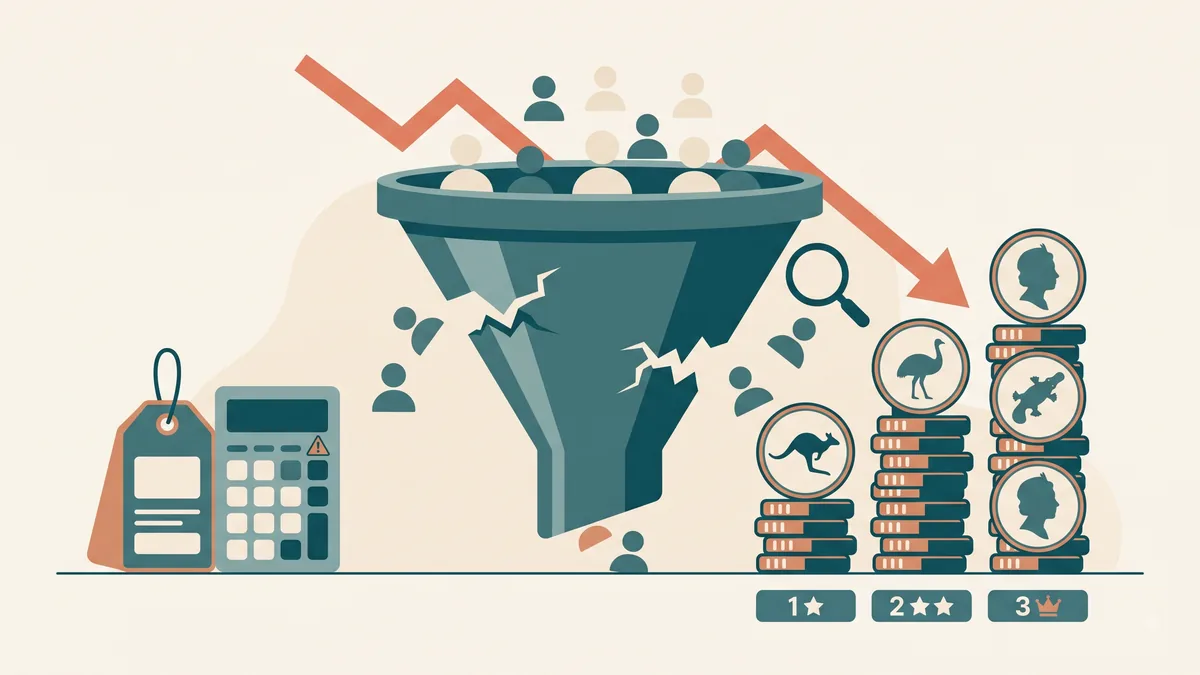
Before diagnosing specific issues, understand the math behind website conversion. If your business receives 1,000 monthly visitors and converts 1% into enquiries, you get 10 leads a month. If you double your conversion rate to 2% through targeted fixes, you double your leads to 20 — without spending an extra dollar on Google Ads, social media marketing, or SEO campaigns.
Fixing conversion leaks provides the highest return on investment (ROI) of any digital marketing activity because it maximizes the value of traffic you are already paying for or earning.
Mobile speed is the single largest point of drop-off for Australian small business websites. Over 70% of organic search traffic in Australia occurs on mobile phones. Research by Google demonstrates that as page load time increases from 1 second to 3 seconds, the probability of a mobile visitor bouncing increases by 32%. At 5 seconds, that bounce probability spikes to 90%.
Furthermore, Google's Core Web Vitals algorithms directly evaluate mobile page speed when determining organic search rankings. A slow site suffers a double penalty: it loses organic visibility on Google, and bounces the visitors who manage to land on it.
The Fix: Compress all images using modern WebP formats, eliminate bloated plugins, and migrate away from legacy WordPress page builders or slow platforms. Read our comparison of WordPress vs Next.js Speed to see the performance difference. Analyze your site's current performance metrics for free using our website speed checker tool.
A website designed primarily on a 27-inch desktop monitor often degrades poorly on a 6-inch mobile screen. Common mobile UX flaws include text that requires pinch-zooming, tap targets placed too close together, pop-up banners blocking content, and hidden contact numbers.
Mobile users navigate with their thumbs. Key conversion elements — such as emergency call buttons, quote forms, and main navigation toggles — must sit within natural "thumb zones" near the bottom and middle of the mobile screen.
tel: link so users can dial with a single tap.The Fix: Audit your website on an actual smartphone (not just a resized desktop browser window). Test completing a quote request using one hand. If any step feels clunky, explore our custom web development services engineered for mobile-first performance.
First-time website visitors decide within 3 to 5 seconds whether your business is relevant to their needs. If your hero headline displays a vague marketing slogan (e.g. "Excellence & Innovation Delivered") instead of stating plainly what you do, who you serve, and where you operate, visitors hit the back button.
Clear value propositions beat clever slogans every time. Compare these two hero headlines:
The Fix: Rewrite your main hero section using the formula: [Primary Service] for [Target Customer] in [City/Region] + [Key Differentiator]. Position your primary call-to-action button directly beneath the headline above the fold.
Many small business websites suffer from CTA ambiguity. Either there is no obvious next step, or the page presents five competing calls-to-action ("Call Us", "Email Us", "Download Brochure", "Follow on Instagram", "Subscribe to Newsletter"). When presented with too many choices, users experience decision fatigue and take no action at all.
A high-converting website establishes a clear primary CTA hierarchy:
The Fix: Choose one primary business goal for each page. Make the CTA button color stand out distinctly from your background, and review our transparent fixed AUD packages to see how we build high-converting conversion funnels.
Australian consumers are naturally cautious online. If a visitor cannot quickly verify that your business is legitimate, licensed, and highly rated by real customers, they will leave for a competitor who offers proof.
Relying solely on text testimonials without verification or using generic stock photography active on hundreds of other sites erodes credibility.
Low conversion despite high traffic usually points to one of five leaks: slow mobile load speed, poor mobile navigation, an unclear headline, missing calls-to-action, or lack of trust signals like Google reviews and trade credentials.
Minor fixes like adding tap-to-call buttons or updating headlines can be done in an afternoon. If your website is constrained by slow mobile page builders like Wix or legacy WordPress setups, a full modern rebuild typically ranges from $800 for a landing page to $1,900 for a multi-page business website.
For local service businesses (tradies, legal, accounting, healthcare), a good website conversion rate is between 3% and 10% of total visitors. Emergency services (plumbing, towing, locksmiths) often convert above 15% when tap-to-call buttons are prominent.
Every additional second of load time reduces conversions by roughly 7% to 10%. Over half of mobile visitors abandon a website if it takes longer than 3 seconds to load. You can test your site's speed score free using our <a href="/website-speed-checker/">website speed checker</a>.
Book a free 30-minute call and we'll turn your idea into a written scope + AUD price within 24 hours.
More from the conversion section