
BuildFirstSite
Web design & development · Australia
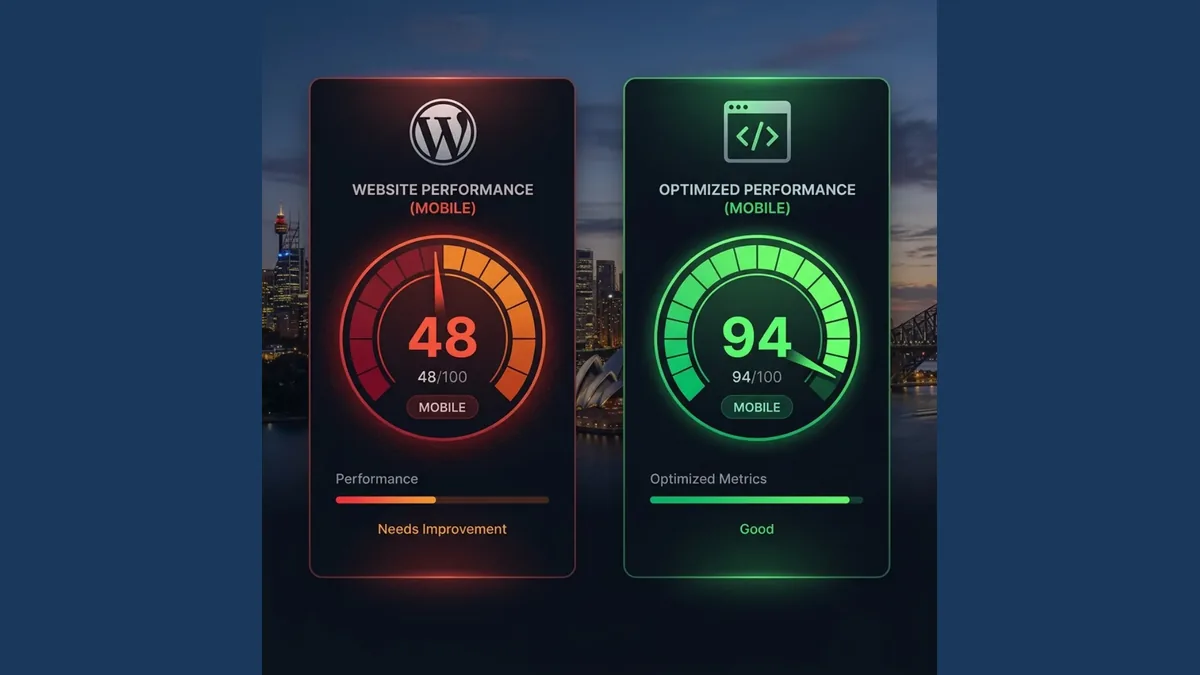
We tested 12 Australian small business websites: 6 built on WordPress (with typical setups — Elementor page builder, WP Rocket caching, managed hosting) and 6 built on Next.js deployed to Vercel. All sites had similar content weight. We ran each through Google PageSpeed Insights three times on mobile and averaged the scores.
The results were consistent. WordPress mobile scores ranged from 38 to 71. Next.js scores ranged from 88 to 98. Average gap: 35 points on mobile PageSpeed.

Average mobile PageSpeed score comparison — WordPress (48) vs Next.js (94)
Google has used Core Web Vitals as a ranking factor since May 2021. The three metrics — Largest Contentful Paint (LCP), Cumulative Layout Shift (CLS), and Interaction to Next Paint (INP) — are directly measured by PageSpeed Insights. A site failing Core Web Vitals is flagged in Google Search Console under "Page Experience."
For local search — the main battlefield for Australian service businesses — Google uses mobile-first indexing. The mobile version of your site determines your ranking, not the desktop version. A score of 42 on mobile is not an aesthetic problem. It is a ranking problem.
Yes — with significant effort. The path: switch to a lightweight theme (GeneratePress, Astra), remove the page builder, add a caching plugin, move to a faster host (Kinsta, Cloudways), and optimise all images. Done properly, a WordPress site can reach 80–90+ on mobile.
The problem is this process often costs more than rebuilding from scratch — and the underlying WordPress overhead never fully disappears. A performance-optimised WordPress site at 88 is an achievement. A stock Next.js build at 94 is the starting point.
For the full platform comparison, see: WordPress vs custom website Australia (2026).
In most real-world configurations, yes. WordPress sites with page builders and standard hosting typically score 40–70 on mobile PageSpeed. Well-built Next.js sites score 88–98. The gap is caused by page builder CSS, plugin JavaScript, and hosting latency — none of which exist in a Next.js build.
Yes. Core Web Vitals (which PageSpeed measures) have been a Google ranking factor since May 2021. The effect is strongest in competitive categories where multiple sites have invested in content quality.
Yes, but it requires significant effort: lightweight theme, no page builder, caching plugin, faster hosting, and image optimisation. A properly optimised WordPress site can reach 80–90+. A default Next.js build starts at 90–98 without any optimisation work.
Book a free 30-minute call and we'll turn your idea into a written scope + AUD price within 24 hours.
More from the performance section