BuildFirstSite
Web design & development · Australia
Three channels bring most enquiries, and SEO only affects two of them.
The practical implication: your website has two audiences with different needs. A coordinator is assessing credibility and service fit. A family is trying to work out whether you can help and how to contact you. Write for both.
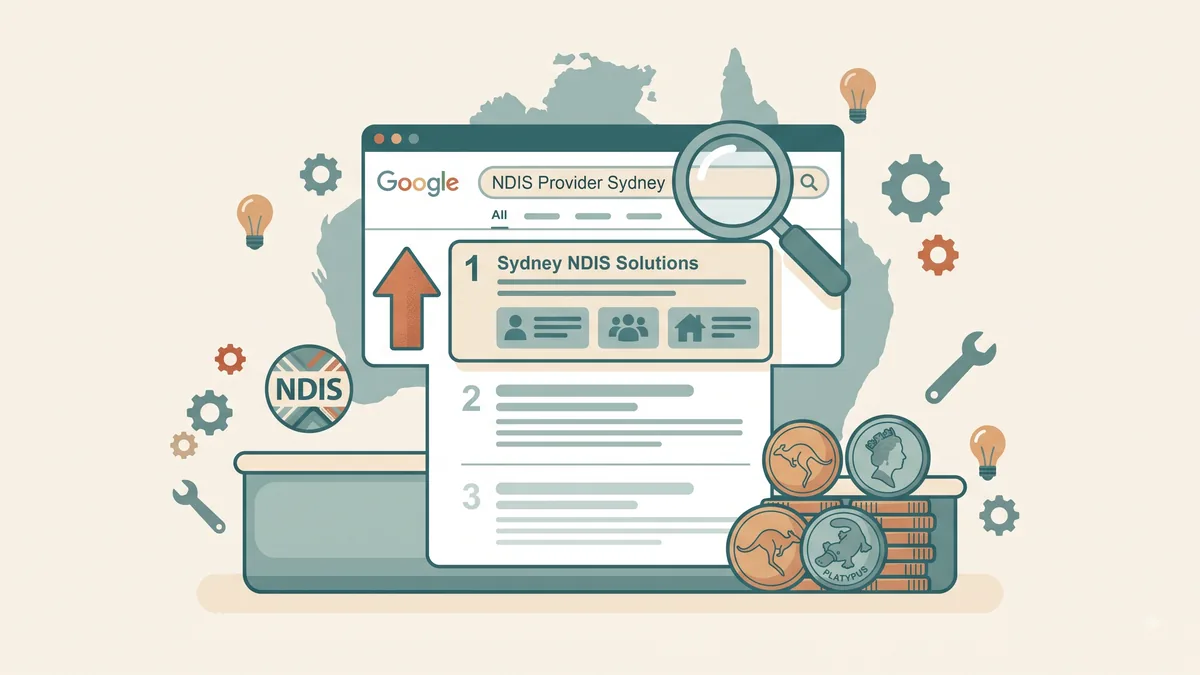
NDIS services are delivered locally, so local search matters more than general SEO. Two things dominate.
Google Business Profile. Free, and it accounts for roughly a third of local ranking weight. Set the primary category correctly — "Disability services provider" or the closest match — fill in every field, list your service areas, and add real photos. An incomplete profile is the most common gap we see.
Reviews. Ask satisfied participants and families, with care and without pressure. Never offer anything in exchange — that breaches Google's policy and Australian Consumer Law. Reply to every review.
Beyond that, keep your name, address and phone number identical everywhere they appear — your site, Google, the Provider Finder, directories. Inconsistency weakens the entity Google builds of your organisation.
This is the single biggest on-site opportunity for most providers.
A page titled "Our Services" listing eight things ranks for none of them. Eight pages, each covering one service properly, can rank for eight different searches. Someone searching "supported independent living Brunswick" should land on a page about supported independent living, not a general services page they then have to navigate.
Each page needs genuine detail — eligibility, what happens first, wait times, who to contact. Eight thin pages are worse than one good one.
This is both an SEO factor and an accessibility one, which is unusual and useful.
Most provider websites are written for auditors. Phrases like "person-centred service delivery frameworks" and "capacity building supports aligned to participant goals" appear on hundreds of sites and mean nothing to a parent trying to find respite care.
Write how people search. Someone types "who can help my son live independently", not "SIL capacity building framework". Answer the question in the words they used, and target a Year 7 to 9 reading level — the same standard our accessibility checklist recommends.
Fast page performance is equally essential for local search rankings and accessibility. Learn how we engineer fast, accessible websites with upfront quotes on our transparent AUD pricing page or test your current page performance on our free website speed checker.
Building an accessible site improves rankings, because most accessibility work overlaps with what search engines need.
For NDIS providers this is the rare case where compliance work and marketing work are the same work.
Expect three to six months before rankings move meaningfully. Anyone promising faster is selling something.
Start with a complete Google Business Profile and genuine reviews, which drive local search where most NDIS enquiries begin. Then build a separate page for each service rather than one combined services page, write in plain English at a Year 7 to 9 reading level, and fix accessibility issues — semantic HTML, alt text and fast mobile pages help both screen readers and search engines. Expect three to six months for meaningful movement.
Yes, and for NDIS providers the overlap is substantial. Semantic HTML and heading structure help both screen readers and search engines parse a page. Descriptive alt text serves blind users and image search. Descriptive link text aids screen reader navigation and passes context to Google. Fast mobile-friendly pages are a WCAG consideration and a confirmed ranking factor.
No. Thirty near-identical suburb pages is exactly the scaled-content pattern Google's helpful content systems target, and a site-wide demotion would take your good pages down with it. Cover your service area properly within fewer, stronger pages, and only build a separate location page where you have a genuine physical presence or distinct service offering.
Three to six months for meaningful ranking movement, longer in competitive metro markets. Google Business Profile improvements can show results within weeks because local search responds faster than organic. Content and authority take longer. Any agency guaranteeing first-page rankings within 30 days is either guessing or targeting terms nobody searches.
Planning a full NDIS provider website? Our NDIS website design service covers WCAG 2.1 AA compliance, fixed AUD pricing, and local SEO built in from day one.
Book a free 30-minute call and we'll turn your idea into a written scope + AUD price within 24 hours.
More from the seo section